
Benefits of Sound Healing & Sound Baths
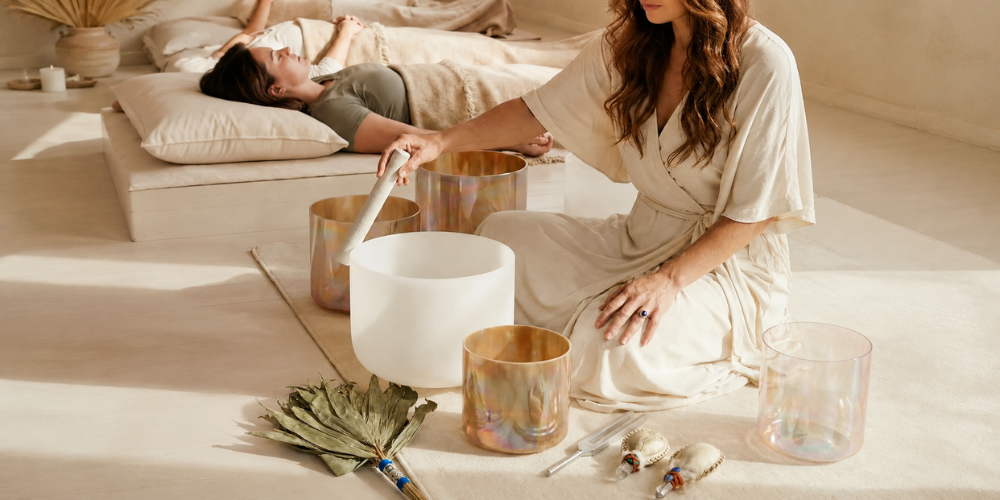
There’s a reason a sound bath feels different from “just listening to music.”
In a sound healing session, you’re not being entertained. You’re being met. The body hears sound as vibration first, then the mind tries to explain it. Some days that land as relief. Other days it lands as tears you didn’t expect. Either way, something shifts.
If you’re here because you’ve been curious about the benefits of sound healing, or you’re wondering what a sound bath is and whether it’s actually worth trying, let’s ground it. What sound therapy is, what science can and can’t claim, why your nervous system responds so strongly, and what a good session should feel like.
What is sound healing and sound therapy?
Sound healing is an umbrella term for using tone, frequency, rhythm, and vibration to support wellbeing. “Sound therapy” is often used as the more clinical label, and can include approaches like sound baths, binaural beats, and vibroacoustic therapy.
A sound bath is the most common entry point. You lie down (usually fully clothed) while a facilitator plays sustained tones from instruments like crystal singing bowls, gongs, chimes, tuning forks, and voice. The goal isn’t to analyze. It’s to let the body settle.
If you want the simplest definition, sound meditation is stillness with sound as the anchor.
How sound frequencies affect the body and brain
You don’t need to believe in anything mystical to understand this part.
Sound is sensory input. The nervous system is constantly scanning input for safety or threat. When the input is steady, spacious, and predictable, many bodies downshift. Breathing slows. Muscles unclench. Thoughts get quieter.
UCLA Health describes sound therapy as something that “may help reduce pain, improve mood and enhance cognition,” while also emphasizing that the research is still inconclusive and growing.
That “growing” part matters. A lot of sound healing conversations are either overconfident or overly dismissive. The truth sits in the middle: the mechanism is plausible, the outcomes vary, and the container (setting, facilitator skill, your current stress load) changes everything.
The science behind sound healing
Here’s what we can say without inflating it.
Singing bowls and mood, tension, and anxiety
A widely cited study on Tibetan singing bowl sound meditation found participants reported lower tension, anger, fatigue, and depressed mood after the session, and reductions in anxiety as well.
Is that “proof” that bowls heal trauma? No. It does support something most people feel firsthand: sound can shift state quickly.
Vibroacoustic therapy benefits (sound you feel, not just hear)
Vibroacoustic therapy uses low-frequency sound and vibration, often delivered through mats, chairs, or beds. Recent research on vibroacoustic sound massage reported reductions in psychological and physiological stress markers in participants.
A scoping review on vibroacoustic therapy in adults experiencing pain also maps a growing body of studies exploring outcomes like pain relief and relaxation, while noting the need for better quality research.
The honest bottom line
The evidence isn’t “settled,” but it’s nothing either. Even UCLA Health frames it as a developing field with promising signals and limitations in study size and design.
Benefits of sound healing
People come to sound healing for all kinds of reasons, but the benefits tend to cluster into a few real-life outcomes.
1) Nervous system regulation
This is the big one. A good sound healing therapy session often helps the body move out of chronic stress mode and into a calmer baseline. Vibroacoustic research specifically looks at stress reduction as a measurable outcome.
2) Emotional release without force
Some people cry. Some people yawn. Some people feel nothing during the session and then sleep deeply that night. Emotional release doesn’t always look dramatic. Sometimes it’s simply the first time your chest feels spacious in weeks. The singing bowl study’s reductions in tension and negative mood states hint at why this happens for many people.
3) Support for anxiety and emotional balance
If you’re searching “sound healing for anxiety,” you’re usually looking for relief that doesn’t require more thinking. Sound-based meditation has shown reductions in anxiety and tension in at least some controlled settings.
4) Pain support (as complementary care)
Sound therapy is sometimes explored for pain management, particularly vibroacoustic approaches. UCLA notes possible pain reduction benefits while again emphasizing that research is still emerging.
5) Better sleep rhythm
This one is common in practice, even if people don’t always track it. When the nervous system settles, sleep can follow. (Not guaranteed, but often noticed after consistent sessions.)
Benefits of a sound bath specifically
A sound bath is a particular flavor of sound therapy. It’s immersive. It’s low-effort. You don’t have to “do it right.”
That’s why sound baths are sometimes described as meditation for people whose minds won’t sit still. Sound gives the mind something gentle to hold, so the body can finally stop bracing.
What people often report after a sound bath:
deep relaxation, sometimes sleep
feeling “lighter” emotionally
quieter thoughts
a softer body, especially the shoulders and jaw
a sense of being reset (not euphoric, just clearer)
Sound healing for anxiety and emotional balance
If anxiety is your baseline, choose steadiness over intensity.
A well-led sound session uses simple principles:
gradual build (no sudden loudness)
predictable arcs (your body trusts rhythm)
grounding at the end (so you don’t leave floaty)
The singing bowl study is a helpful reference point here because it measured changes in mood and anxiety after a single session.
And UCLA’s overview reinforces that sound therapies are being explored for mood and stress support, even as research continues to develop.
Types of sound healing modalities
Not all sound therapy is the same. If you’ve tried one and didn’t love it, it might not be “you.” It might be the modality.
Sound bath: crystal bowls, gongs, chimes, voice. Best for stress relief and deep rest.
Sound frequency therapy: sometimes includes tuned frequencies, tones, and targeted sound tools.
Vibroacoustic therapy: low-frequency vibration delivered through equipment. Often studied for stress and pain support.
Binaural beats: audio tones designed to influence attention and brain states, studied in task and cognition contexts, with mixed evidence.
Voice and mantra: vocal toning, chanting, guided sound. Powerful for people who want to feel sound from the inside out.
Drumming and rhythm-based work: can be grounding, energizing, or trance-inducing depending on pacing.
What to expect in a sound healing session
A good session is simple and well held.
You arrive, settle, maybe set a quiet intention.
You lie down comfortably (blanket, pillow, whatever helps you feel safe).
The facilitator begins gently, then builds the soundscape slowly.
You’re invited to breathe, soften, and let the body respond.
You’ll have time at the end to reorient, hydrate, and integrate.
If you want to explore sound work in the Anahata world, start at the home page and follow the Sound Healing path from there.
Is sound healing right for you?
Usually, yes, with a few practical notes.
Sound healing can be a beautiful fit if:
you’re stressed, burnt out, or emotionally overloaded
you want a nervous system reset that doesn’t require heavy talking
you love meditation but struggle with silence
you’re seeking gentle emotional release and inner balance
Use extra care (or ask questions first) if:
you’re very sound-sensitive or easily overwhelmed by loud tones
you have a history of seizures triggered by sensory input
you’re in an acute mental health crisis (sound can support you, but it shouldn’t be your only support)
A skilled facilitator will welcome these questions.
FAQ
What is a sound bath?
A sound bath is a type of sound meditation where you rest while instruments like singing bowls, gongs, and chimes create sustained tones around you. It’s designed to support relaxation and nervous system downshifting, with no effort required beyond resting and listening.
What are the benefits of sound healing?
The most common benefits of sound healing include stress reduction, calmer mood, emotional release, and improved relaxation. Research is still developing, but early studies and clinical overviews suggest sound therapies may help reduce pain and improve mood for some people.
Does sound healing really work?
“Work” depends on your definition. Evidence is mixed and still emerging, but studies on singing bowl meditation and vibroacoustic approaches show measurable shifts in mood and stress markers in some settings. For many people, the biggest effect is nervous system regulation and deep rest.
Is sound healing safe?
For most people, yes. It’s noninvasive and generally low-risk. The key is pacing and volume, especially if you’re sound-sensitive. If you have a medical condition affected by sensory stimulation, it’s wise to ask the facilitator about modifications or consult your clinician first.
How often should I do a sound bath?
If you’re using sound baths for stress or anxiety support, once a week is a common rhythm. Some people benefit from shorter, more frequent sessions. Pay attention to how you sleep and feel afterward, then build consistency around what your body can actually integrate.
Closing
Sound doesn’t argue with you. It doesn’t ask you to “figure it out.” It meets you where you are, and if your system is ready, it helps you soften.
That’s the quiet power behind the benefits of sound healing, not as a miracle, but as a language your nervous system understands.
If you want to explore sessions, trainings, or retreats through Anahata, start here.