
Isis: The Egyptian Goddess of Magic, Motherhood, and Healing
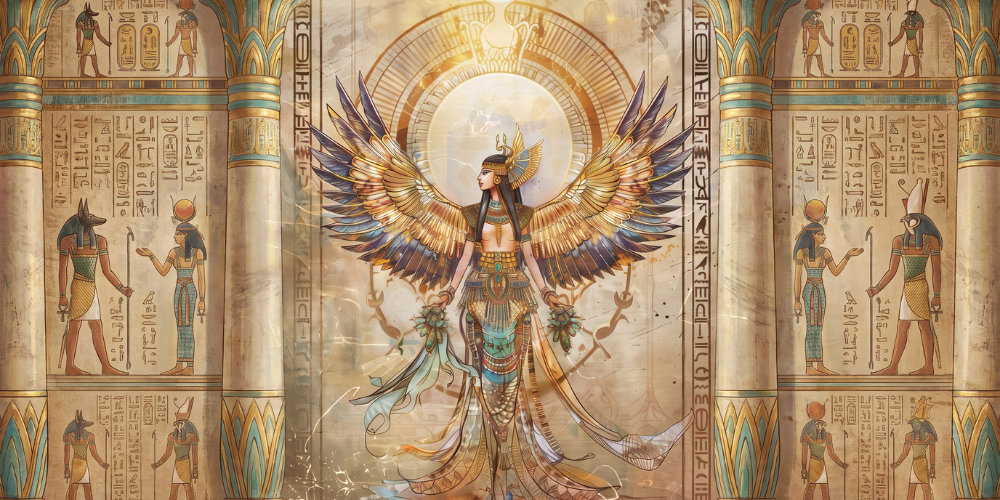
The Egyptian goddess Isis was known for magic, healing, motherhood, protection, and her devotion to Osiris and Horus. Her story is one of love tested by death, a woman gathering what has been broken, and life returning in a form no one expected.
Perhaps that is why Isis still feels so close.
She isn’t a goddess untouched by ordinary pain. She searches for someone she has lost. She mourns. She raises her child under threat. She relies on intelligence, patience, and magic rather than brute force.
The history belongs to ancient Egypt. The way we meet her inwardly today is something else. Both deserve room.
Who Is the Egyptian Goddess Isis?
Her names, titles, and origins
Isis is the Greek form of her name. In ancient Egyptian, she was called Eset or Aset. Her name was written with the hieroglyph for a throne, which she often wears as a crown in ancient images. That throne connected her with royal authority and with the pharaoh, who was identified with her son Horus.
She belonged to one of Egypt’s central divine families. Isis was the daughter of Nut and Geb, sister and wife of Osiris, sister of Nephthys and Set, and mother of Horus. Among her titles was Weret-Hekau, often translated as “Great of Magic.”
Still, titles only take us so far. Isis became beloved because her power was never remote. She used it to search, protect, heal, mourn, and restore.
What was Isis the goddess of?
People often ask, “Who is Isis the goddess of?” There isn’t one neat answer.
She was associated with:
Magic and sacred knowledge
Healing and protection
Motherhood and fertility
Marriage and devotion
Mourning and the care of the dead
Kingship through Horus
Rebirth through the restoration of Osiris
In some stories, she appears as a queen. In others, she is a grieving widow, a mother hiding with her child, or a woman traveling alone in search of help. That range brought her close to people far beyond the royal court.
The Myth of Isis and Osiris
The story of death, devotion, and resurrection
The best-known story of Isis begins with Osiris.
Set kills his brother Osiris and takes his throne. Isis goes looking for her husband’s body, finds it, and brings it home. When Set later tears the body apart and scatters the pieces, she searches again.
She does not find an untouched body waiting to be returned to its former life. She gathers what remains.
With Nephthys beside her, Isis mourns Osiris and uses her magic to restore him. Osiris does not return permanently to the world of the living. He becomes ruler of the afterlife, while Isis conceives Horus, the child who will eventually challenge Set and reclaim his father’s inheritance.
It is tempting to turn this into a simple story about refusing to let go. I think it carries something more difficult.
Isis cannot make the past exactly as it was. Her love creates a future, but it does not erase death. What has been lost changes form.
Anyone who has lived through grief knows that kind of restoration.
Isis as the mother of Horus
Isis raises Horus while hiding him from Set. In magical stories, she protects him from illness, venom, and danger. Later images of Isis nursing the young Horus became some of the most familiar representations of the goddess. Many were placed in temples and shrines, not only those devoted solely to Isis.
This is why she became known as the great mother.
Not because she represents a polished image of motherhood, free from anger, exhaustion, or fear. Isis mothers in the middle of danger. Her tenderness has vigilance inside it. She loves her child while preparing him to enter a difficult world.
Isis’s Powers and Symbols
Magic, healing, and protection
Magic was central to Isis, but Egyptian magic wasn’t merely a spectacle. It was used to protect life, address illness, defend against danger, and restore order.
Isis is called upon in ancient stories and magical texts as a healer and protector. One tale describes her healing Horus after a scorpion sting. In the Osiris myth, her wings bring breath and life back to her husband.
Her magic comes through knowledge. She watches closely. She learns names. She speaks with purpose. She understands what the situation asks of her.
That kind of power feels very different from control for its own sake.
The throne, wings, and tyet knot
Three symbols appear again and again around Isis.
The throne is tied to her name and her relationship with kingship. You may see it balanced directly on her head in statues and amulets.
Her wings appear in funerary and protective imagery. They recall the bird form she takes while mourning Osiris and the breath of life she brings to him.
The tyet, sometimes called the Knot of Isis, looks somewhat like an ankh with its arms folded downward. By the New Kingdom, it had become closely associated with Isis and was used as an amulet of protection for the dead.
She is also shown with cow horns holding a solar disk, imagery she came to share with Hathor as the identities and attributes of the two goddesses grew closer.
Isis as the Great Mother and Divine Feminine
Her place in goddess worship across the ancient world
Isis did not remain a local Egyptian goddess.
Her worship grew from the Nile Delta throughout Egypt and then spread across the Mediterranean into Greece and Rome. Evidence of her cult has been found as far away as Britain. She became associated with sailors, merchants, families, rulers, healing, fate, and the promise of life beyond death.
Her temple at Philae continued as an important center of worship for centuries and remained active into the sixth century CE, long after many older religious sites had closed.
Why did Isis matter to so many different people?
Partly because her story traveled well. Nearly anyone could recognize something in her. She had known love and danger. She had been a queen and a wanderer. She protected a child, mourned a partner, and found a way forward without pretending that nothing had been lost.
Why did her cult spread beyond Egypt?
As Isis entered Greek and Roman religious life, her worship adapted. She absorbed new titles and associations without losing the central qualities that made her recognizably Isis.
She could be approached as a mother, healer, protector, keeper of mysteries, or guardian of travelers at sea. Her appeal reached women and men, royalty and ordinary people.
That adaptability made her larger than a single role.
It also reminds us why the phrase “divine feminine” should never be reduced to softness alone. Isis is loving, but she is also clever. She is maternal, but not passive. She grieves deeply and continues to act.
The Modern Meaning of Isis: Her Archetype Today
Devotion, magic, and reclamation
The modern archetypal Isis is not identical to the goddess as ancient Egyptians knew her. I think we should say that clearly.
Still, an old myth can open a living question.
What have you lost that cannot be returned in its original form?
What part of yourself was scattered through grief, duty, survival, or the need to remain acceptable?
Where are you being asked to gather rather than abandon?
Isis teaches reclamation without pretending that healing means going backward. She works with what remains. She does not wait for the pieces to arrange themselves.
Her medicine differs from the fierce fire of Sekhmet, the Egyptian goddess of healing. Sekhmet confronts and burns through. Isis searches, protects, and patiently brings things back together.
There are times for both.
Working with Isis on the priestess path
You don’t need to recreate an ancient ritual or claim an identity that isn’t yours.
Begin with attention.
Sit quietly with an image of Isis. Notice what draws you first. Is it the wings? The throne? Is the mother holding her child? The woman searching for someone she loves?
Then ask a question you’re ready to answer honestly:
What part of my life is asking to be gathered home?
Write before you edit yourself. The answer may not sound mystical. It may be your confidence, your health, your creativity, your capacity to trust, or your right to receive care.
The Awakening the Goddess Within Mystery School offers a longer path into goddess archetypes, divine feminine healing, and personal transformation. Isis is held there not as a distant figure to admire, but as a mirror through which women can explore their own wisdom and power.
Honoring Isis Through Reflection and Sacred Practice
Place a bowl of water before you. Light a candle. Give yourself ten quiet minutes without asking the moment to become profound.
Think of something you believed was gone.
Not necessarily a person. It may be a feeling, a dream, a version of yourself, or a relationship with your own body.
Ask what can be restored and what must be created differently now.
This is the part of Isis’s story I return to. She doesn’t deny what happened. She doesn’t call the breaking beautiful just because she survived it. She gathers with care, and from that gathering, a new life begins.
Those who feel called to experience Egypt through its temples, Nile landscapes, meditation, ceremony, and goddess traditions can explore Anahata’s Sacred Union Retreat. The journey is led by Shehera Barnes, whose work through Anahata is deeply connected with Egyptian mystery traditions and sacred feminine practice.
You can also read our guide to yoga retreats in Egypt for a wider look at what a spiritually grounded journey through Egypt can include.